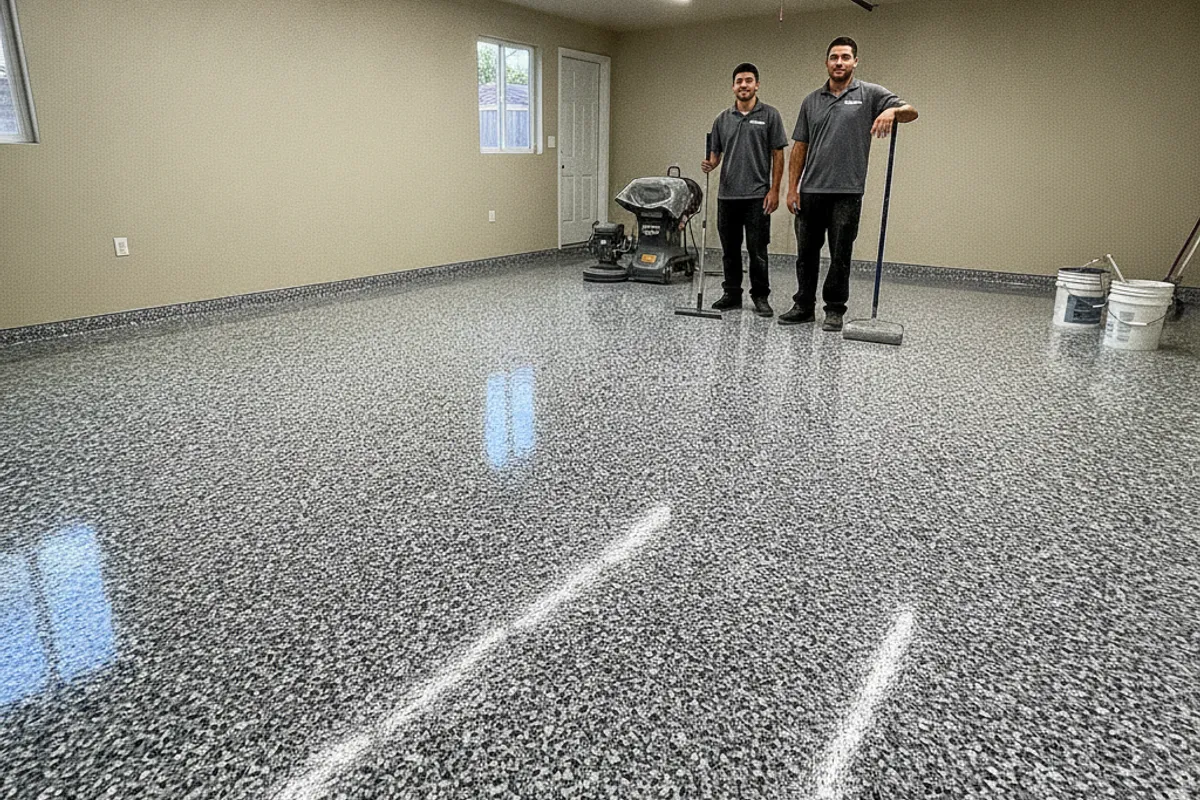
Flake chip floors: popular for a reason, but worth understanding before you buy
Walk through any neighborhood in Poway, Santee, or El Cajon and knock on a garage door. Odds are good the homeowner either has a flake chip floor or has thought about one. This finish has become the default recommendation in San Diego County for a reason, but “popular” is not the same as “right for every situation.”
This guide covers what flake chip systems actually consist of, why they perform the way they do, what they cost, and where they fall short, so you can decide whether the upgrade is worth it for your garage.
What a flake chip system actually is
A flake chip floor, often called a broadcast or vinyl flake system, is not a separate product. It is a technique layered on top of a base epoxy coating.
Here is the basic sequence:
- The concrete is mechanically ground to open the surface profile
- An epoxy base coat is applied, usually pigmented
- Vinyl flake chips are hand-broadcast into the wet epoxy at full saturation or partial broadcast coverage
- The epoxy cures and the excess flakes are scraped off
- A clear topcoat, either epoxy or polyaspartic, is applied over the flake layer and sealed
The result is a surface with texture, visual depth, and a layer of embedded color that does not sit on the surface the way paint does. Because the flakes are sealed under the topcoat rather than on top of it, they do not peel or chip off under normal garage use.
Why San Diego homeowners choose this finish
There are four main reasons flake chip systems dominate in San Diego:
Appearance. The flakes break up the flat, industrial look of solid-color epoxy. Most people find the multicolor blend more attractive in a home setting. There are dozens of color blends available, from neutral grays and beiges to bold contrasts.
Texture and slip resistance. The flake layer adds natural texture to the surface. This is meaningful in garages where the floor gets wet, whether from rain tracking in, hose-downs, or washing vehicles. For households in coastal communities like Encinitas or Carlsbad where damp floors are common, texture is a real safety benefit. Our anti-slip coating service goes into more detail on texture options and their performance differences.
Hides imperfections. A solid-color floor highlights every scratch, scuff, and tire mark. The multicolor flake pattern visually absorbs surface wear. For high-traffic garages used as workshops, gym spaces, or storage areas, this is a practical advantage.
Conceals the substrate. San Diego has a lot of older concrete slabs, particularly in La Mesa, Spring Valley, and older parts of El Cajon. These slabs often have discoloration, ghost stains from old equipment, and uneven surface tone. A flake broadcast at full saturation covers all of that.
What the system actually costs
In San Diego County, flake chip systems typically run $1 to $1.50 per square foot more than a comparable solid-color epoxy installation. On a standard two-car garage at roughly 400 to 450 square feet, that is $400 to $675 added to the base cost.
The total installed cost for a full flake system on a two-car garage generally runs between $2,200 and $3,800, depending on floor condition, chip coverage density, and whether the topcoat is epoxy or polyaspartic. A polyaspartic topcoat adds UV stability and is worth the incremental cost in garages with direct sun exposure.
Partial broadcast systems, where chips are scattered at 25 to 50 percent coverage rather than full saturation, cost somewhat less and create a speckled effect rather than a fully covered surface. Some homeowners in Escondido and Poway prefer the look of partial broadcast; others want the full coverage. Both are valid and your contractor can show you samples of each.
Flake size and color choices
Chips come in several standard sizes: 1/16 inch, 1/4 inch, and occasionally larger. Most residential garages use 1/4-inch chips. Smaller chips create a finer, more uniform texture. Larger chips are sometimes used for commercial or industrial applications.
Color blends are sold as pre-mixed bags. Common residential options include:
- Neutral blends: gray, white, and black mixed for a concrete-like appearance with added depth
- Earth tones: tans, browns, and greens popular in inland San Diego communities
- Bold blends: red/black, blue/white, and similar combinations common in workshop and hobby spaces
Most contractors carry a standard set of 10 to 20 blends and can order custom mixes. Ask to see physical samples rather than photos on a screen; color accuracy varies significantly between a screen and a physical chip in your specific garage lighting.
Where flake chip systems fall short
Honest answer: this system is not for everyone.
They are harder to repair spot-by-spot. If a section of a solid-color floor gets damaged, a patch can often be blended in invisibly. With a flake floor, a local repair will rarely match the original blend perfectly. Full-section repairs are possible but more involved.
They show dust more than you might expect. The texture that helps hide tire marks also catches dust and debris in the valleys between flakes. A leaf blower or shop vac handles this easily, but homeowners expecting a wipe-clean surface sometimes find it takes more effort than anticipated.
They require a properly trained applicator. Full-saturation broadcast work is a skill. Flakes have to go into the wet epoxy at the right rate and with even coverage. Thin spots, clumps, or incomplete coverage are not easy to fix after the fact. Ask any contractor about their experience specifically with broadcast systems, not just epoxy in general.
They are not appropriate over all substrates. Concrete with significant active moisture vapor drive needs a moisture barrier coating applied first. Skipping this step on a problematic slab will cause the entire system to delaminate over time, regardless of the chip broadcast on top.
How to evaluate a flake chip quote
When comparing quotes for this system, here is what to look for:
- Does the prep scope include mechanical grinding, not just acid etching or sweep-and-coat
- What is the base coat product and mil thickness
- What broadcast coverage density are they proposing, full or partial
- What topcoat are they using, epoxy or polyaspartic, and what is the build thickness
- What is the warranty and what does it cover
In California, contractors who apply coatings typically hold a C-33 painting and decorating license. Before signing with anyone, verify their license at cslb.ca.gov. Epoxy Coat SD is a referral service. We connect homeowners with insured contractors and encourage you to independently verify contractor licensing before any work begins.
The verdict: is it worth it
For most San Diego homeowners, yes. The added cost over a solid-color epoxy system is modest, and the practical benefits, better slip resistance, stronger visual appeal, and better wear concealment, are real. If your garage sees regular use, multiple vehicles, or functions as a multipurpose space, the upgrade typically justifies itself in appearance and durability over time.
Where it is less obviously worth it: very low-use garages, garages where aesthetics are not a priority, or situations where the budget is genuinely tight and a solid epoxy system would otherwise meet the need.
Get a quote for your San Diego garage
Epoxy Coat SD connects homeowners across San Diego County with insured contractors experienced in flake and chip broadcast systems. We serve Chula Vista, Poway, Santee, El Cajon, La Mesa, Escondido, Encinitas, Carlsbad, Spring Valley, and surrounding communities.
Call (858) 925-5546 to get matched with a local contractor for a free on-site estimate.