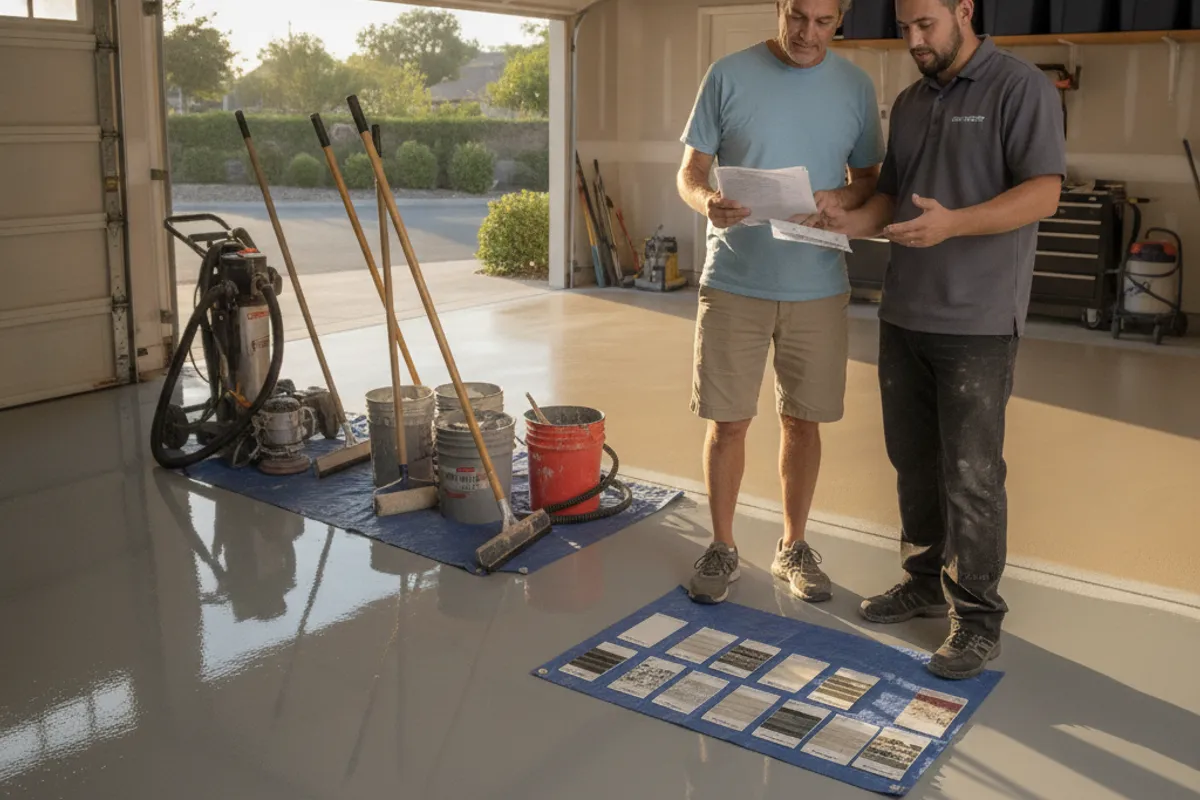
Most floor coating mistakes happen before the first coat goes down
The epoxy installer you hire will make or break the project. The best materials applied by someone cutting corners on preparation will fail within a year. An average product applied by someone who preps the concrete correctly will last for years without issue.
This guide walks you through how to evaluate contractors, what questions to ask, what licenses to verify, and which red flags to walk away from before you sign anything. San Diego has no shortage of epoxy contractors. The challenge is telling the difference between a skilled professional and someone who will be hard to reach after the floor starts peeling.
Start with license verification
California requires contractors to be licensed through the Contractors State License Board (CSLB). For garage floor coating work, the relevant license is the C-33 (painting and decorating contractor), though some specialty epoxy contractors operate under a C-61/D06 (surface finishing) license.
Before you do anything else, go to cslb.ca.gov and verify the contractor’s license number. Enter the license number or the business name and confirm:
- The license is current and active
- The license type matches the work being performed
- The license holder’s name matches the business you are dealing with
- There are no disciplinary actions on the record
This takes about three minutes and filters out a significant percentage of unqualified contractors immediately. Do not skip it and do not take a contractor’s word that they are licensed. Look it up yourself.
Also verify they carry general liability insurance. Ask for a certificate of insurance with your name listed as the certificate holder. A reputable contractor will provide this without hesitation.
How to get quotes that are actually comparable
Getting three quotes is standard advice. The harder part is making sure the quotes are covering the same scope so you can actually compare them.
When you contact contractors, tell them:
- The square footage of the garage (measure it yourself before the call)
- The current condition of the floor: any cracks, previous coatings, oil stains, or known moisture issues
- How the space is used: vehicle parking, gym, workshop, storage
- Your timeline
Ask each contractor to provide a written quote that breaks out:
- The surface preparation method (grinder, shot blaster, acid etch)
- Whether a moisture test is included
- The specific coating system: brand and product name if possible
- Number of coats and approximate total mil thickness
- Whether a topcoat is included
- Warranty terms on labor and materials
- Timeline and what happens if conditions require additional prep
If a contractor gives you a verbal quote and resists putting it in writing, that is an early signal about how disputes will be handled later.
The preparation question is the most important one
Ask every contractor you speak with: what preparation method do you use?
The correct answers are diamond grinding or shot blasting. These are mechanical methods that open the pores of the concrete and create the surface profile that coatings need to bond properly. They require specialized equipment and operator skill.
Some contractors still use acid etching as their primary prep method. Acid etching works only on raw, uncoated concrete in good condition. It does nothing to remove previous sealers or coatings, it cannot address weak surface laitance, and it does not create the same profile that mechanical methods achieve. Many failed floors trace back to acid-etch-only prep.
If a contractor tells you they grind the concrete, ask whether they use a single-disc grinder or a planetary grinder. Planetary grinders cover more surface area consistently and leave a more uniform profile. This distinction matters for larger floors.
This is also when to ask about concrete repair. Cracks, spalls, and divots need to be addressed before any coating goes down. Ask what their process is for identifying and repairing problem areas. A contractor who has no answer to this question is planning to coat right over whatever they find.
A concrete grinding and prep step done properly is the foundation of everything that follows. If a contractor is vague or dismissive about this part of the process, that tells you a lot.
What to ask about the coating system
Not all epoxy coatings are equal. The products used by professional contractors are different from hardware store kits. When a contractor gives you a quote, ask:
- Is this a 100% solids epoxy, or a water-based system?
- What is the solids content of the product?
- What is the warranty from the manufacturer on the product?
- Are you using an epoxy base coat with a polyurethane or polyaspartic topcoat?
A professional epoxy coating system for a garage typically involves a primer or base coat, a color layer (often with vinyl flake broadcast), and a topcoat for protection. Each layer serves a purpose. A single-coat system without a topcoat is a lower-cost option that will show wear and UV yellowing faster.
If aesthetics matter to you, this is also when to discuss finish options. Many homeowners in areas like Poway, Rancho Bernardo, and Carlsbad want a floor that matches an upgraded garage interior. The conversation about color, flake patterns, and sheen level should happen before the contractor starts, not during.
Moisture testing: ask directly
Moisture vapor in the concrete slab is the single most common cause of coating failure in San Diego. Ask every contractor: do you test for moisture before coating, and what do you do if the results are elevated?
A contractor who tests should be able to tell you what method they use (calcium chloride or in-situ relative humidity probe), what threshold triggers additional mitigation, and whether a moisture barrier primer is included in the scope or is an add-on.
A contractor who does not test for moisture is gambling with your floor. If the moisture vapor emission rate exceeds what the coating system can tolerate, the coating will delaminate. The floor will need to be stripped and redone.
This applies across the county but is particularly relevant in lower-elevation coastal areas including Chula Vista, National City, Lemon Grove, and coastal neighborhoods in San Diego proper.
Red flags to walk away from
The following are not minor concerns. Each one is a reason to decline and keep looking.
No written contract or scope of work. If you cannot get the scope in writing before work starts, you have no recourse if something goes wrong.
License cannot be verified at cslb.ca.gov. No license means no accountability. Move on.
Significantly lower bid with no explanation. A dramatically lower quote usually means something is being skipped. Ask what is different about the scope. If they cannot answer, that is your answer.
Pressure to sign same day or lose a discount. Urgency tactics are a pressure strategy. Reputable contractors do not need them.
No moisture testing and dismissive when you ask about it. This is a direct indicator that the contractor is not following professional installation standards.
No examples of completed work and no references. An experienced contractor in San Diego will have photos of past jobs and can provide references on request. If neither is available, that is a meaningful gap.
Acid etching described as equivalent to grinding. It is not. A contractor who presents them as equivalent either does not know the difference or is hoping you do not.
What the quote process should look like
A professional contractor will want to see the floor before quoting it. Remote quoting based on square footage alone can work for a rough estimate, but a contractor should visit the site before giving a final number. The condition of the concrete, the presence of previous coatings, cracks, or moisture issues all affect scope and price.
During the site visit, they should be looking at the slab condition carefully, asking about the history of the floor, and checking for any areas that will need special attention. If a contractor shows up, spends three minutes looking around, and hands you a number without asking questions, be skeptical.
The timeline for an average two-car garage is typically one to two days, depending on the system. Some fast-cure polyaspartic systems allow same-day return to foot traffic. Standard epoxy systems cure overnight before light use and need 72 hours or more before parking vehicles. Ask for specifics in writing.
Getting connected with qualified installers
Epoxy Coat SD is a referral service, not a contractor. Verify any installer at cslb.ca.gov. We connect San Diego homeowners with insured professionals who perform proper surface preparation, test for moisture, and stand behind their work. We serve the entire county, from Oceanside and Vista in the north to Chula Vista and Spring Valley in the south.
Verify any contractor’s license at cslb.ca.gov before you sign. Ask for insurance certificates. Get everything in writing.
Call us at (858) 925-5546 to get connected with a vetted installer for your garage floor project.