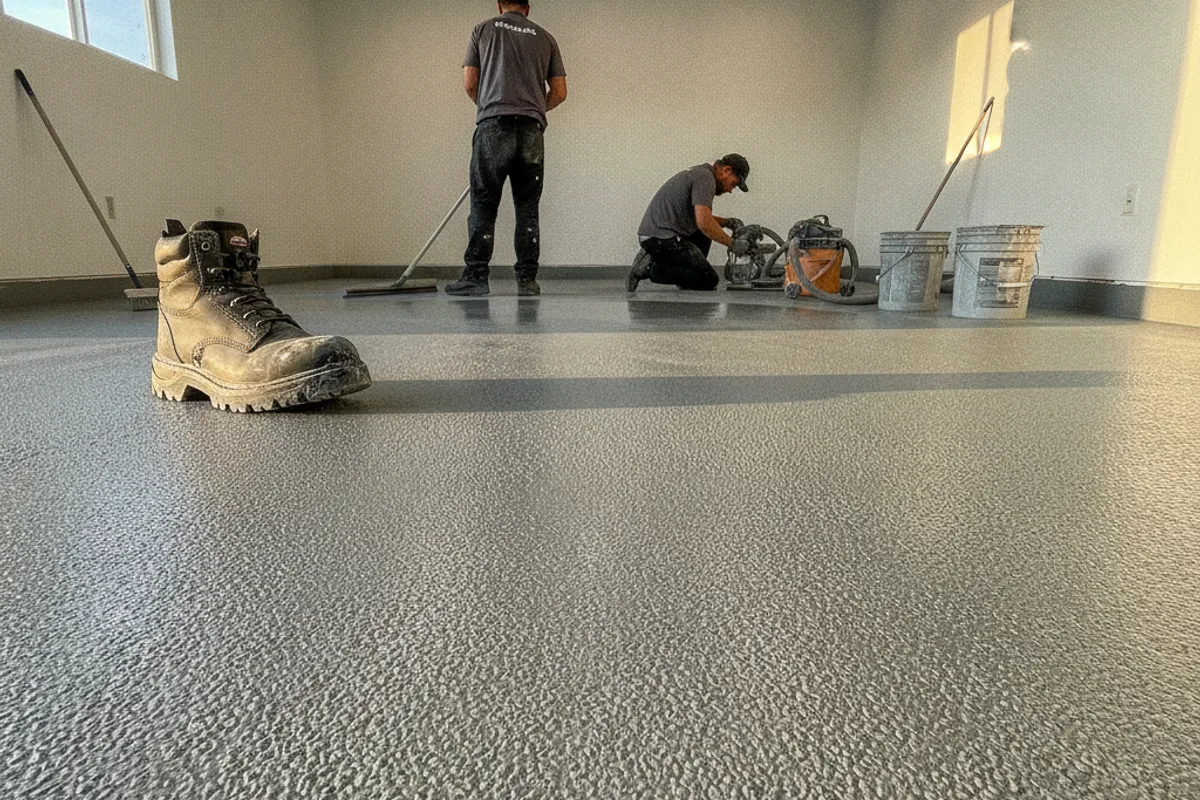
The traction problem with smooth epoxy
A fresh epoxy floor looks great. The glossy surface reflects light, makes the garage feel cleaner, and holds up to oil and chemicals. But smooth epoxy gets slippery when wet, and in a garage, wet happens. You track in rainwater. You wash the car. Something spills. Add a concrete surface with zero texture and you have a surface that can be genuinely hazardous underfoot.
This is not a theoretical concern. It is one of the most common complaints from homeowners after a garage floor coating job, and it is entirely preventable. The right anti-slip option depends on how you use the space, your aesthetic preferences, and who spends time in the garage.
Why garages need more traction than living spaces
Garages are transition zones. You walk in from outside, potentially in wet shoes. You work on vehicles. You move equipment. In San Diego, garages are often used year-round as workshops, gyms, or hobby spaces. Families with kids or older adults have more at stake.
Coastal neighborhoods from Carlsbad to Coronado see more moisture tracked in from outside. Inland areas like Poway, Ramona, and Escondido have drier conditions but are not immune. Any time water hits a smooth, high-gloss epoxy surface, traction drops.
The good news is that anti-slip additives and finishes are standard in the professional epoxy industry. They are not a specialty product or a significant upcharge. They are a normal part of specifying the right floor for the intended use.
Option 1: Broadcast vinyl flake
The most common and arguably most practical anti-slip solution for residential garages is a vinyl flake or chip broadcast system. The installation involves broadcasting decorative colored chips into a wet base coat. The chips land at varying angles and create natural micro-texture across the surface.
A flake and chip floor system does two things at once: it creates traction through physical texture, and it produces the multi-color speckled look that has become the standard for residential garage floors in San Diego.
The level of traction depends on broadcast density. A full broadcast, where chips cover the entire surface, produces more texture than a partial broadcast. Most residential installs use a full or near-full broadcast for maximum coverage and traction. The topcoat is then applied over the chips to lock them in and provide chemical resistance.
The topcoat matters here. A matte or satin topcoat reduces gloss and adds to the slip-resistant feel. A high-gloss topcoat over full-chip coverage still provides reasonable traction because of the texture from the chips, but a lower-sheen topcoat is often the right call in a working garage.
Option 2: Anti-slip aggregate added to the topcoat
For floors where you want a cleaner, more minimalist look without visible flakes, an anti-slip aggregate can be mixed directly into the topcoat. The most common additives are:
Aluminum oxide. A hard angular mineral that creates texture without being visible to the naked eye. It is the standard choice for commercial applications and works well in residential garages. It does not change the color or sheen of the topcoat in any significant way.
Silica sand. A coarser option than aluminum oxide, more visible in the finished surface, and more aggressive in texture. Good for areas with heavy foot traffic or where water exposure is frequent.
Polymer grit. A softer option than aluminum oxide, slightly more comfortable underfoot, still effective for light to moderate traction needs.
The aggregate is mixed into the topcoat at a specified ratio before application. The result is a floor that looks smooth from a distance but has actual texture underfoot. This approach is popular on metallic epoxy floors where the visual effect is the primary design goal and visible flakes would interrupt the aesthetic.
Option 3: Textured topcoat products
Some professional coating systems include topcoats that are formulated with built-in texture rather than requiring a separate aggregate. These products have a specified coefficient of friction and are designed for commercial and industrial floors where traction requirements are regulated.
For residential garages in San Diego, this option is less common but worth asking about if your contractor works primarily in commercial settings. They may have access to products that provide excellent traction with a predictable finish.
Option 4: Anti-slip coating as a standalone service
If you already have an epoxy floor that is too slippery, a topcoat with anti-slip additive can sometimes be applied over the existing surface without a full re-installation. This depends on the condition of the current coating, whether it is still well-bonded, and whether the surface profile allows for proper adhesion of a new topcoat.
An anti-slip coating service is a more targeted solution for this situation. Not every contractor offers it, and the existing floor needs to be assessed before anyone can tell you whether it is viable. If the existing coating is peeling or has adhesion problems, a topcoat is not the answer.
What level of traction do you actually need?
Not all garages need the same level of anti-slip treatment. Here is a practical way to think about it:
Light use (storage, occasional foot traffic): A vinyl flake broadcast with standard topcoat provides adequate traction. This is the entry-level option and handles most residential situations fine.
Moderate use (home gym, workshop, regular vehicle parking): Full-broadcast flake with a satin topcoat, or aggregate mixed into the topcoat. Either approach gives you good day-to-day traction.
Heavy use (frequent water exposure, commercial-style use, household members with mobility concerns): Higher aggregate concentration or a commercial-grade textured topcoat. If someone in the household has balance or mobility issues, this is the right call.
Pool deck or patio adjacent areas: Patio and pool deck coatings have their own traction requirements because the surfaces are frequently wet. These applications typically specify higher aggregate concentration or purpose-built non-slip topcoats rated for wet-area use.
How anti-slip treatments hold up over time
Anti-slip texture does wear over time, especially in high-traffic areas like the path from the car to the door. The rate depends on the type of additive and the finish system.
Broadcast vinyl flake systems with a topcoat hold up well because the chips themselves are embedded in the coating, not sitting on top of it. The topcoat wears first, which is normal and expected. Reapplying the topcoat restores both the gloss and the slip resistance without redoing the entire floor. Most residential garage floors in San Diego see topcoat reapplication every five to ten years depending on use.
Aggregate-in-topcoat systems can become smoother over time as the topcoat wears and the grit particles erode with traffic. High-concentration aggregate formulations last longer than light concentrations. In areas with frequent cleaning (which removes surface oxidation), the texture tends to hold longer.
If you are noticing your existing floor becoming more slippery over time, topcoat wear is the most likely explanation. An assessment from a qualified installer will tell you whether a fresh topcoat is the fix or whether the base system needs attention.
Special considerations for multigenerational households
San Diego has a large number of multigenerational households where older parents or grandparents live with the family. Garage floors in these homes deserve a higher standard of traction than a typical single-adult household.
The Americans with Disabilities Act specifies a minimum wet static coefficient of friction of 0.6 for walking surfaces, and 0.8 for ramps. These numbers come from OSHA and ADA guidance and are the reference most flooring professionals use when specifying accessible surfaces.
For a household where someone regularly uses a walker, cane, or wheelchair, the aggregate concentration in the topcoat should be on the higher end, and the topcoat sheen should be matte rather than high-gloss. A contractor who regularly installs commercial flooring will be familiar with these specifications. Residential-only contractors may need to be specifically asked about them.
If mobility is a factor, mention it when you are getting quotes and ask the contractor to specify the coefficient of friction for the system they are proposing. If they cannot provide that number, ask whether they can get it from the product data sheet.
Asking the right questions when you get quotes
When you talk to an epoxy contractor about anti-slip options, ask:
- What is the coefficient of friction (COF) for the system you are proposing? A wet COF of 0.6 or higher is the standard threshold for slip resistance.
- Is the anti-slip additive going into the topcoat or is it a broadcast system?
- What topcoat sheen are you recommending, and why?
- Can you show me examples of the texture level I should expect?
A contractor who can answer these questions clearly is one who has thought through the application properly. One who says “it will be fine” without being specific is worth pressing for more detail.
Verify the contractor before you sign
Epoxy Coat SD is a referral service connecting San Diego homeowners with insured epoxy contractors. Epoxy Coat SD is a referral service, not a contractor. Verify any C-33 or applicable license at cslb.ca.gov before hiring. Before hiring any contractor, verify their C-33 or applicable license at cslb.ca.gov and confirm they carry liability insurance.
We serve homeowners across San Diego County including Chula Vista, El Cajon, Santee, La Mesa, Poway, Escondido, Encinitas, Carlsbad, and surrounding areas.
Call us at (858) 925-5546 to get connected with a qualified installer who will specify the right anti-slip system for your garage.