The honest breakdown most blogs skip
Walk into any big-box hardware store in El Cajon or Escondido and you will find epoxy floor kits on the shelf. The packaging makes the job look straightforward: clean the floor, apply the coating, done. Plenty of San Diego homeowners give it a shot. Some are happy. Many call a professional six to eighteen months later when the coating starts peeling.
This guide does not exist to sell you on one approach. It exists to give you an accurate picture of what each path actually involves so you make a decision you won’t regret.
What the DIY kits get right
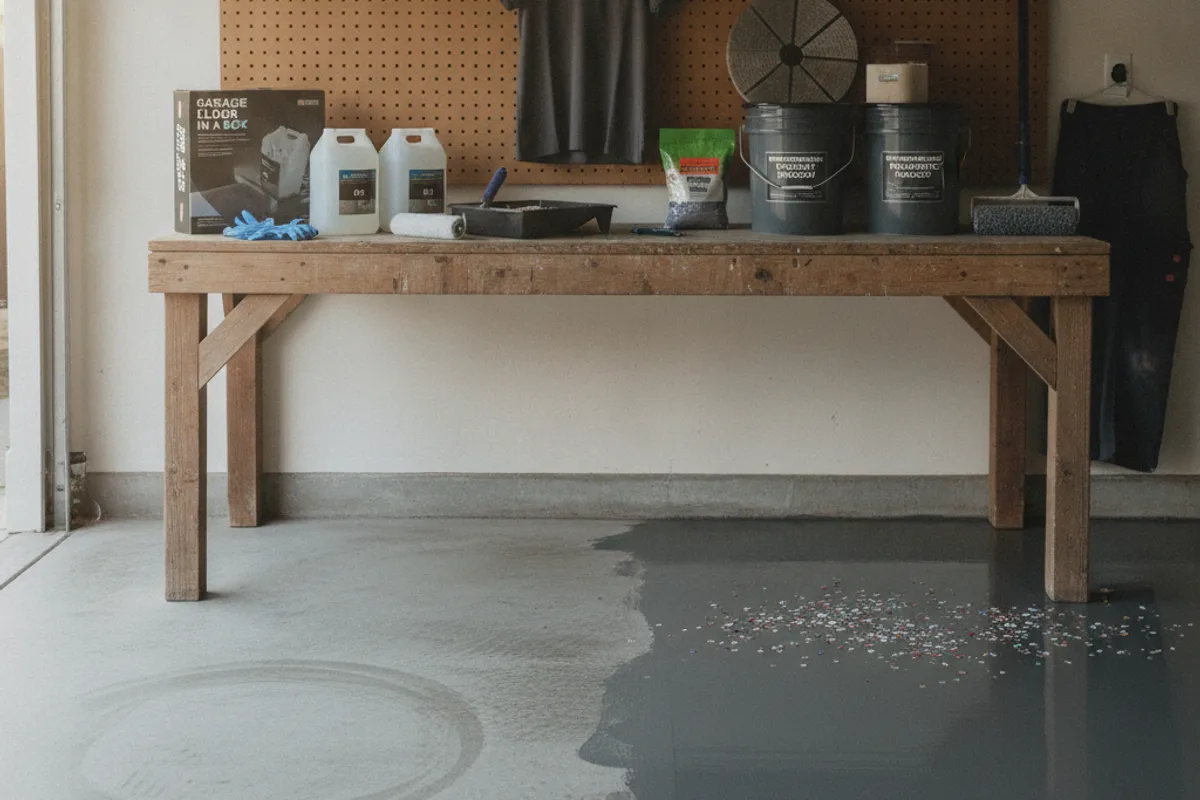
Box-store epoxy kits have improved. The better ones include a two-part epoxy or epoxy-polyurea hybrid, color flakes, and basic surface prep instructions. For a small single-car garage in a place like Spring Valley or La Mesa, a quality kit can work if you execute it correctly.
The upside of DIY:
- Upfront cost is lower, often $100 to $300 for a single-car garage
- You control the timeline
- The process is manageable for someone with patience and attention to detail
Those are real advantages. The problem is that most of the critical variables are invisible to someone doing this for the first time.
Where DIY goes wrong
Surface preparation is the whole game
Concrete must be profiled before any coating bonds to it. Profiling means opening the pores of the concrete so the epoxy has something to grip. Professionals do this with diamond grinders and shot blasters. Most DIY kits suggest acid etching.
Acid etching works on raw, porous concrete. In San Diego, a significant number of garages have concrete slabs that were previously sealed, painted, or finished with a curing compound applied during the original pour. Acid etching does almost nothing to those surfaces. The coating goes down looking fine and starts delaminating within months.
Without a grinder or shot blaster, you also cannot properly address laitance, which is the weak surface layer that forms on concrete as it cures. Coating over laitance is a reliable path to peeling.
Moisture is a bigger problem here than people expect
San Diego’s climate feels dry, but concrete slabs in coastal areas from Encinitas to Chula Vista can carry significant moisture vapor. Ground moisture migrates upward through the slab constantly. If the moisture vapor emission rate exceeds what the coating system can handle, the coating delaminates from below.
Professional installers test for moisture before they start. DIY kits do not include this step, and most homeowners skip it. A moisture barrier coating applied before the topcoat is the standard fix, but you need to know you have a moisture problem before you can address it.
Product quality is not equivalent
The two-part epoxy in a hardware store kit is not the same product professionals use. Commercial-grade coatings have higher solids content, better chemical resistance, and significantly longer abrasion resistance. A box-store kit might last two to four years under light use. A professionally applied system is typically warranted for several years and lasts much longer with normal care.
Temperature and humidity windows are narrow
Epoxy is sensitive to application temperature and humidity. In San Diego, this is manageable but not automatic. Applying epoxy when the concrete is too cold (below about 55 degrees Fahrenheit) or when humidity is high leads to a compromised cure. Professionals monitor and work around these conditions. First-time DIYers often do not know to check.
What professional installation actually includes
A professional epoxy coating job from a qualified contractor in San Diego typically involves:
Concrete grinding and prep. Not acid washing. Actual mechanical profiling with equipment that costs thousands of dollars. This is the step DIY cannot replicate without renting professional gear.
Moisture testing. A professional will test moisture vapor emission before applying anything. If moisture is elevated, they address it with a moisture barrier coating before the finish system goes down.
Crack and spall repair. Cracks and divots in the concrete are filled and feathered before coating. A DIY applicator often coats right over them, and the coating telegraphs every imperfection.
Commercial-grade materials. The products professionals apply have higher solids content and are formulated for the application environment.
Proper film thickness. Getting the coating to the correct mil thickness across the entire floor requires skill and the right equipment. Thin spots are weak spots.
Topcoat. Most professional systems include a polyurethane or polyaspartic topcoat that protects the color layer and provides chemical and UV resistance. Many DIY kits skip this or offer it as an add-on.
The real cost comparison
DIY cost for a two-car garage (roughly 400 square feet):
- Kit: $150 to $400 depending on quality
- Rental grinder if you go that route: $80 to $150 per day
- Miscellaneous supplies: $40 to $80
- Total: $270 to $630, plus your time (plan for a full weekend minimum)
Professional cost for the same two-car garage in San Diego:
- Typical range: $1,200 to $2,500 depending on concrete condition, system chosen, and contractor
- Includes prep, materials, labor, and topcoat
The cost gap narrows when you factor in that a professional job done right may last three to four times as long. If a DIY floor fails in two years and you pay to have it professionally removed and recoated, you spent more than if you hired a professional the first time.
The situations where DIY makes sense
DIY is a reasonable option when:
- The garage is used lightly, primarily for storage rather than vehicle parking
- The concrete is in excellent condition with no previous coatings, no cracks, and no moisture issues
- You are willing to rent a proper grinder and invest the time to prep the surface correctly
- You understand this is a shorter-term solution and you are comfortable with that
The situations where professional installation is clearly the better call
Hire a professional when:
- The floor will bear the weight of vehicles regularly
- The concrete has visible cracks, spalling, or previous coating that needs removal
- The garage is in a coastal area where moisture is more likely
- You want the job to last and carry any kind of warranty
- The floor area is large (three-car or tandem garages)
Neighborhoods in inland San Diego like Santee, Poway, and Rancho Bernardo have older housing stock where garages were built in the 1970s and 1980s. Those slabs often have surface issues that require professional prep to address properly.
What happens when a DIY floor fails
The most common failure mode for a DIY epoxy floor is delamination: sections of the coating separate from the concrete and start peeling. This usually happens within the first year, often faster.
At that point, you are not looking at a touch-up. Failed epoxy coating has to be completely removed before anything new can go down. Removal requires grinding, which means renting professional equipment or hiring someone to do it. After removal, the concrete has to be re-prepped properly, and any underlying issues (moisture, laitance, previous sealer residue) have to be addressed before a new coating can be applied.
The cost of failure is roughly the cost of doing the job right the first time, plus the cost of the failed attempt. Homeowners in areas like Santee, El Cajon, and Escondido who have called for professional remediation after a failed kit installation consistently find that the total spend ends up higher than a professional job would have been.
If you are considering DIY primarily to save money, factor this scenario into the math. It is not a rare outcome.
How to find a qualified installer in San Diego
If you decide to hire, verify the contractor holds a C-33 license (finish contractor license from the California Contractors State License Board). You can check license status at cslb.ca.gov. A C-33 is what you want for this type of work. Some epoxy contractors operate under a C-61/D06 specialty license, which can also be appropriate.
Get at least two quotes. Ask each contractor what moisture testing they perform, what prep method they use, and what warranty they offer on labor and materials. A contractor who cannot answer those questions clearly is worth passing on.
Get a quote from a vetted San Diego installer
Epoxy Coat SD connects homeowners across San Diego County with insured epoxy contractors who use professional-grade systems and proper surface preparation. Epoxy Coat SD is a referral service, not a contractor. Verify any installer at cslb.ca.gov. The installers we refer have verifiable credentials you can confirm.
Call us at (858) 925-5546 to describe your project. We will connect you with a qualified installer in your area, whether you are in Carlsbad, El Cajon, Chula Vista, or anywhere else in the county.