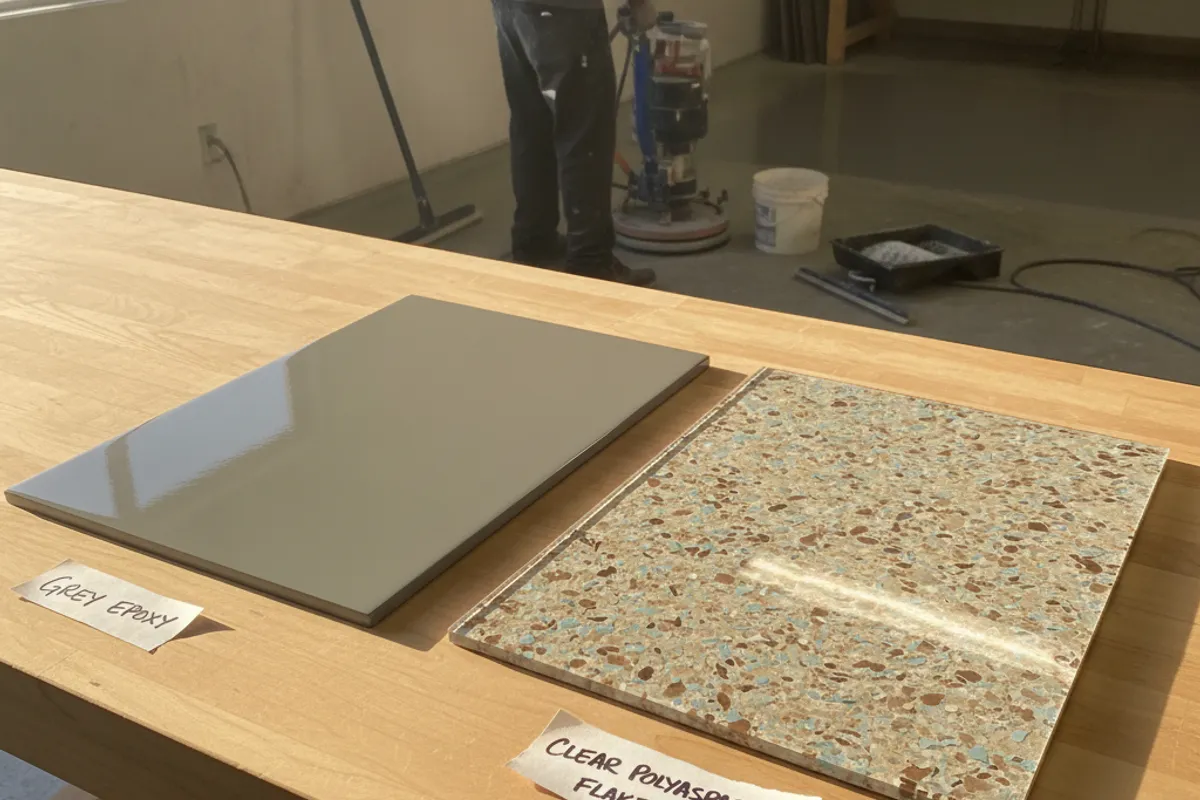
Two strong systems, two different tradeoffs
If you have been researching garage floor coatings in San Diego, you have almost certainly run into both epoxy and polyaspartic as options. Contractors recommend both. Both can produce attractive, durable results. But they are not interchangeable, and choosing the wrong one for your situation can mean slower cure times, premature yellowing, or spending more than you need to.
This guide explains how each system works, where each one performs better, and how to decide which fits your garage, your timeline, and your budget.
How epoxy coating works
Epoxy is a two-part system: a resin and a hardener that chemically cross-link when mixed. Once applied to properly prepared concrete, that bond creates a rigid, high-strength surface that resists most chemicals, hot tire pickup, and heavy foot traffic.
Standard epoxy has been used in garages, warehouses, and industrial facilities for decades. It is proven. The chemistry is well understood. A quality epoxy system installed over mechanically prepped concrete should last 10 to 20 years with basic maintenance.
The tradeoff is cure time. Epoxy cures relatively slowly. Most residential jobs need 24 hours before foot traffic and 72 hours or more before vehicle parking. In some conditions, full cure takes up to a week. For households that depend on regular garage access, this window is a real inconvenience.
Epoxy is also vulnerable to UV exposure over time. In San Diego garages with south- or west-facing doors that let in direct afternoon sun, a standard epoxy topcoat will yellow and chalk within a few years. This does not affect structural performance, but it does affect appearance.
How polyaspartic coating works
Polyaspartic is a newer chemistry derived from polyurea technology. It was developed in part to solve the cure-time and UV problems that epoxy presents. Polyaspartic coatings cure in a fraction of the time, handle UV exposure without yellowing, and can be applied at a wider range of temperatures.
A typical polyaspartic garage floor job can be complete, cured, and ready for foot traffic within the same day. Vehicle traffic is usually permitted within 24 hours. For homeowners in Carlsbad, Encinitas, or Poway who need their garage back quickly, this is a meaningful advantage.
Polyaspartic also forms a harder surface than most epoxy formulations. This scratch resistance is particularly useful if the garage doubles as a workshop.
The tradeoffs: polyaspartic materials cost more than epoxy. The chemistry also cures fast by design, which means contractors have less working time to correct runs, bubbles, or coverage gaps during application. Proper technique and temperature management matter more with polyaspartic than with epoxy. A contractor who works with epoxy regularly but applies polyaspartic infrequently is more likely to have application problems.
Our polyaspartic coating service page goes into more detail on what the application process looks like and what to expect on installation day.
Side by side: the comparison that matters
Here is a practical breakdown for San Diego homeowners:
Cure time Epoxy: 24 to 72 hours minimum, often longer for vehicles. Polyaspartic: same-day foot traffic, vehicles within 24 hours.
UV stability Epoxy: will yellow under direct sun exposure over time. Polyaspartic: UV stable, will not yellow or chalk.
Durability Both are durable in normal residential use. Polyaspartic is harder and more scratch resistant. Epoxy has a longer performance track record.
Application temperature range Epoxy: performs best between 50 and 90 degrees Fahrenheit. Can have issues below 55 degrees. Polyaspartic: can be applied in a wider range, including cooler mornings in inland San Diego communities like Ramona or Escondido.
Cost Epoxy is typically less expensive per square foot installed. Polyaspartic adds 15 to 30 percent to the material cost. On a standard two-car garage, expect polyaspartic to run $400 to $700 more than a comparable epoxy system.
Color and appearance options Both systems support color tints, decorative flake broadcast, and clear topcoats. Metallic effects are more commonly achieved with epoxy base systems due to the longer working time, but polyaspartic topcoats are often used over epoxy bases to add UV stability.
The hybrid approach: epoxy base, polyaspartic topcoat
A growing number of contractors in San Diego use a hybrid system: an epoxy base coat for excellent concrete adhesion and build, topped with a polyaspartic clear coat for UV stability and faster final cure. This approach captures the strengths of both chemistries.
If you are looking at a flake or chip floor system, this hybrid structure is common. The epoxy base goes down, flakes are broadcast into it, the excess is removed after cure, and then a polyaspartic topcoat seals everything. See our flake and chip floor service for how that full system is assembled.
Which one is right for your situation
Use this as a starting framework:
Choose standard epoxy if:
- Your garage is interior-facing with no direct sun exposure
- Budget is a primary consideration
- Your timeline allows for a two-day installation window
- You want a decorative metallic effect with maximum working time for the installer
Choose polyaspartic if:
- Your garage door faces south or west and gets direct afternoon sun
- You need the garage back in use as quickly as possible
- Scratch resistance matters, for example if you park heavy vehicles or use the space as a workshop
- You are in a coastal community (Carlsbad, Encinitas, Del Mar) where UV exposure is consistent year-round
Consider the hybrid system if:
- You want flake or chip broadcast with long-term UV stability on the topcoat
- Your contractor recommends it based on your specific slab and climate conditions
- You are open to a slightly longer cure window than pure polyaspartic but want UV protection
Questions to ask your contractor
When getting quotes, these questions help you understand exactly what you are being sold:
- Is this a single-component or two-component epoxy system? (Two-component systems are more durable)
- What is the polyaspartic percentage in your topcoat? (Higher aliphatic polyaspartic content means better UV stability)
- Are you using an epoxy base or polyaspartic throughout?
- What is the minimum dry film thickness of the total system?
- What is your warranty on adhesion failure?
Any reputable contractor should be able to answer these without hesitation. If you get vague answers, that is worth noting before signing.
In California, contractors installing floor coatings typically hold a C-33 painting and decorating contractor license. You can verify any contractor at cslb.ca.gov before work begins. Epoxy Coat SD is a referral service connecting homeowners with insured contractors. Epoxy Coat SD is a referral service, not a contractor. Verify any installer at cslb.ca.gov.
The bigger picture: surface prep determines everything
Whether you choose epoxy, polyaspartic, or a hybrid, the single biggest factor in how long the coating lasts is surface preparation. No coating chemistry will adhere properly to concrete that has not been mechanically ground or shot-blasted to open the surface profile.
Our concrete grinding and prep service explains what proper prep looks like and why bids that skip this step are a false economy. A failing coating is not a chemistry problem, it is almost always a preparation problem.
Get matched with a San Diego contractor
Epoxy Coat SD connects homeowners across San Diego County with insured contractors experienced in both epoxy and polyaspartic systems. Whether you are in Chula Vista, La Mesa, Spring Valley, Escondido, Santee, Poway, or anywhere in between, we can help you get accurate quotes for the right system.
Call (858) 925-5546 to request a free estimate and talk through which coating fits your garage.