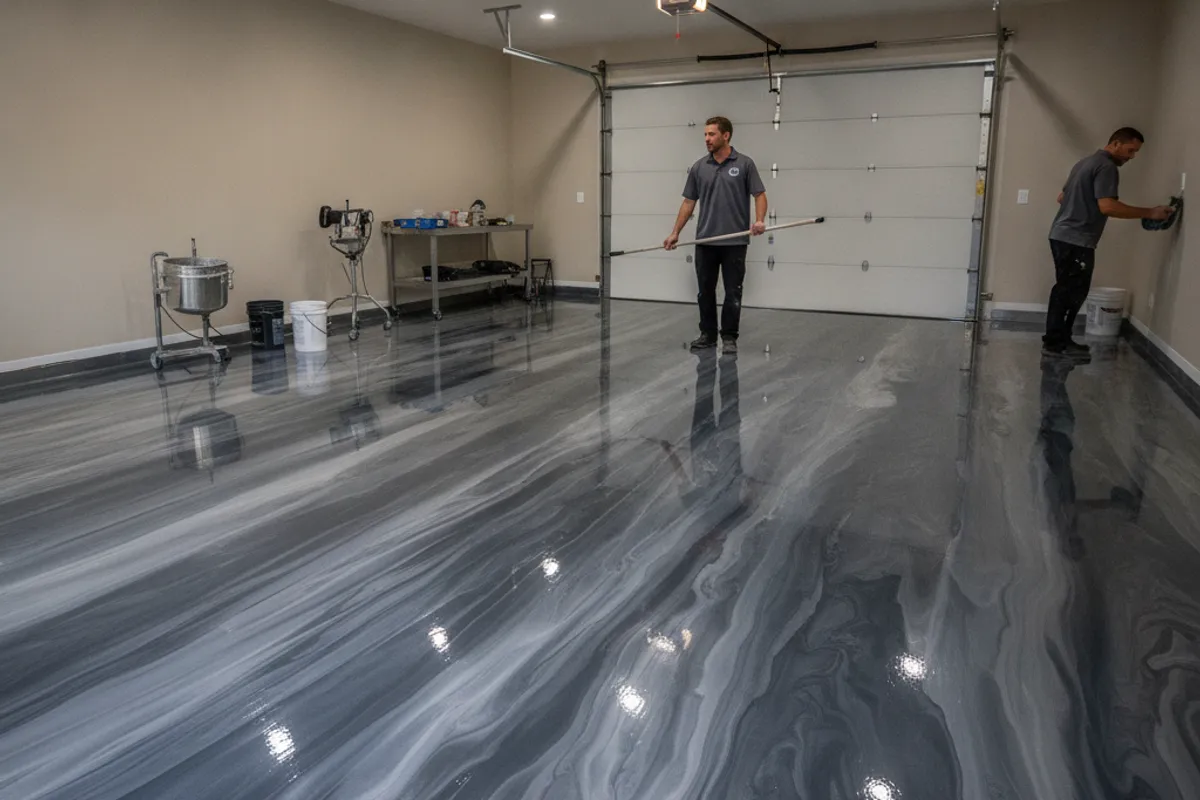
What metallic epoxy actually is
Metallic epoxy is one of the most visually striking floor finishes available for residential garages, but it is also one of the most misunderstood. Walk into a showroom, see the photography, and it is easy to assume it is some kind of poured stone or specialty tile. It is not. It is a coating system, and understanding how it works will help you evaluate whether it is right for your garage and how to find a contractor who can actually execute it.
At its core, metallic epoxy is an epoxy resin system with metallic or pearlescent pigment suspended in it. When that pigmented epoxy is poured and worked across a prepared concrete surface, the pigment particles move, swirl, and layer in ways that create depth and movement in the finished floor. No two metallic epoxy floors look exactly alike, which is part of the appeal and part of the challenge.
How the system is applied
Metallic epoxy is not rolled on the same way a standard epoxy coating is. The application process is more involved and requires a contractor with specific experience in this finish.
Here is the general sequence:
Surface preparation. The concrete must be mechanically ground to a proper surface profile, usually CSP 2 or CSP 3, before anything else happens. No metallic effect will compensate for a floor that delaminated because the prep was inadequate. This step is the same regardless of which coating system follows it.
Primer coat. A clear or pigmented epoxy primer is often applied first to seal the concrete and provide a consistent base. This layer matters especially on older slabs in communities like El Cajon, Spring Valley, or older parts of Escondido where concrete can be porous or variable.
Metallic epoxy pour. The pigmented epoxy is poured in sections across the floor. Installers use a combination of squeegees, rollers, and sometimes forced air from a heat gun or torch to move the material and create the swirling, flowing effect that defines the look. Different techniques produce different patterns. Some installers blend multiple metallic colors in the pour for more complex effects.
Topcoat. Once the metallic layer cures, a clear protective topcoat is applied. Most quality contractors use a polyaspartic or aliphatic urethane clear for this layer because it is UV stable. Metallic epoxy base coats are not UV stable on their own, so skipping the right topcoat will result in yellowing and haze in garages with sun exposure. Given how many garages in Carlsbad, Encinitas, and Chula Vista face direct afternoon sun, this is not a step to skip.
Our metallic epoxy service has more detail on what the full system looks like and what homeowners can expect during installation.
The look: what you can and cannot control
This is the part that surprises most people. Metallic epoxy produces a unique floor, but the specific final appearance cannot be precisely replicated from a photo you found online or a sample you saw in someone else’s garage.
The variables that affect the final look include:
- The metallic pigment colors chosen and how they are blended
- The temperature and humidity on installation day
- The concrete porosity and profile of your specific slab
- The installer’s technique and how they move the material
- The topcoat sheen level (high gloss versus satin)
Skilled installers work within these variables to guide the floor toward a general aesthetic direction: flowing versus textured, light versus dark, single-tone versus blended. What they cannot do is guarantee an exact match to a reference image. If a contractor promises you an exact replica of a photo, that should give you pause.
The most productive conversation with an installer is about direction: do you want something dramatic and dark with deep contrast, or lighter and more subtle? Silver tones, bronze tones, or color-based metallics like blue or green? Wide flowing movement or tighter, more veined patterns?
Color choices and popular combinations in San Diego
San Diego homeowners tend to lean toward certain color families for metallic epoxy:
Silver and charcoal blends are the most common. They complement the neutral tones of most garage interiors and work well with gray house exteriors, common throughout Poway, Rancho Bernardo, and North County communities.
Bronze and copper tones are popular in craftsman-style homes in older neighborhoods in La Mesa, Lemon Grove, and parts of National City. The warm tones complement wood trim and earthier exterior palettes.
Black base with gold or silver metallic creates a dramatic, high-contrast finish. This is common in custom home garages and showroom-quality spaces, and is often seen in larger garages in Rancho Santa Fe and Olivenhain.
Color-based metallics like deep blue, forest green, and burgundy are less common but exist. These work best when the garage aesthetic is intentional, meaning the homeowner is treating the space as an extension of the home rather than just a utility floor.
What metallic epoxy costs in San Diego
Metallic epoxy is the premium option in the residential coating category. Installed costs in San Diego County typically run between $7 and $12 per square foot for a complete system, primer through topcoat.
On a standard two-car garage of 400 to 450 square feet, that puts a metallic epoxy floor in the $2,800 to $5,400 range. On a three-car garage or oversized space, costs can reach $7,000 or more, particularly when multiple metallic colors are blended or when the floor requires significant preparation work.
The higher cost reflects several factors: more expensive pigment materials, greater labor intensity per square foot, longer installation time due to the technique-based application, and the higher skill level required from the installer. You are paying for artisan work, not just a coating application.
If budget is the primary driver, a flake and chip system delivers a decorative finish at a meaningfully lower price point. If the specific visual impact of metallic epoxy is what you are after, the cost difference is the cost of that outcome.
Durability: what to expect over time
A properly installed metallic epoxy floor is as durable as any other quality epoxy system. The metallic pigment is embedded in the base coat and sealed under the topcoat, so it does not rub off or fade with normal use.
Standard maintenance is minimal: sweep or dust mop regularly, clean spills promptly, and avoid dragging sharp metal objects across the surface. The same basic care applies to any epoxy coating.
What can damage metallic epoxy over time:
UV exposure without the right topcoat. As noted above, the metallic base coat is not UV stable. A polyaspartic or aliphatic urethane topcoat is not optional on a garage with sun exposure. This is a point worth confirming explicitly with any contractor.
Improper prep. A metallic epoxy floor that delaminated failed at the prep stage, not the metallic stage. Verify that your contractor uses mechanical grinding as part of their prep process before signing.
Heavy impact. Metallic epoxy is not indestructible. Dropping heavy tools or equipment repeatedly in the same area will eventually mark any epoxy system.
How to find a contractor who can actually do this
Metallic epoxy is a genuinely skilled application. Not every epoxy contractor does it regularly, and quality varies more than it does with standard coating systems. Here is what to look for:
- Ask to see photos of metallic floors they have installed in San Diego, not stock images
- Ask how many metallic jobs they complete per year
- Ask what products they use for the metallic base and clear topcoat, specifically whether the topcoat is aliphatic or aromatic (aliphatic = UV stable; aromatic = will yellow)
- Ask for a reference from a metallic job you can contact or visit
In California, flooring contractors typically hold a C-33 painting and decorating contractor license. Verify any contractor’s license at cslb.ca.gov before committing. Epoxy Coat SD is a referral service connecting homeowners with insured contractors. We do not hold a contractor license, and we encourage you to verify licensing independently.
Is metallic epoxy right for your garage
The honest answer depends on what you want the space to feel like. If the garage is purely functional, a vehicle storage area you never think about, metallic epoxy is probably not the right investment. The finish pays off in spaces that are used, shown, or valued as part of the home.
Where it makes clear sense: custom homes in Rancho Santa Fe, Del Mar, and La Jolla where the garage is a design detail. Workshop and hobby spaces where the homeowner wants an environment that feels finished. Showroom-quality garage setups. Newly remodeled homes where the garage is part of a whole-home renovation.
If you are drawn to the look but not certain, ask a contractor to show you flake chip options alongside metallic options. The flake system delivers visual interest at a lower price and may satisfy what you are after, or you may see both and confirm that the metallic finish is what you want.
Get a metallic epoxy quote in San Diego
Epoxy Coat SD connects San Diego County homeowners with insured contractors experienced in metallic epoxy systems. We serve Chula Vista, La Mesa, Spring Valley, Escondido, Santee, Poway, Encinitas, Carlsbad, and the wider San Diego area.
Call (858) 925-5546 to get matched with a local contractor for a free estimate on your garage floor.