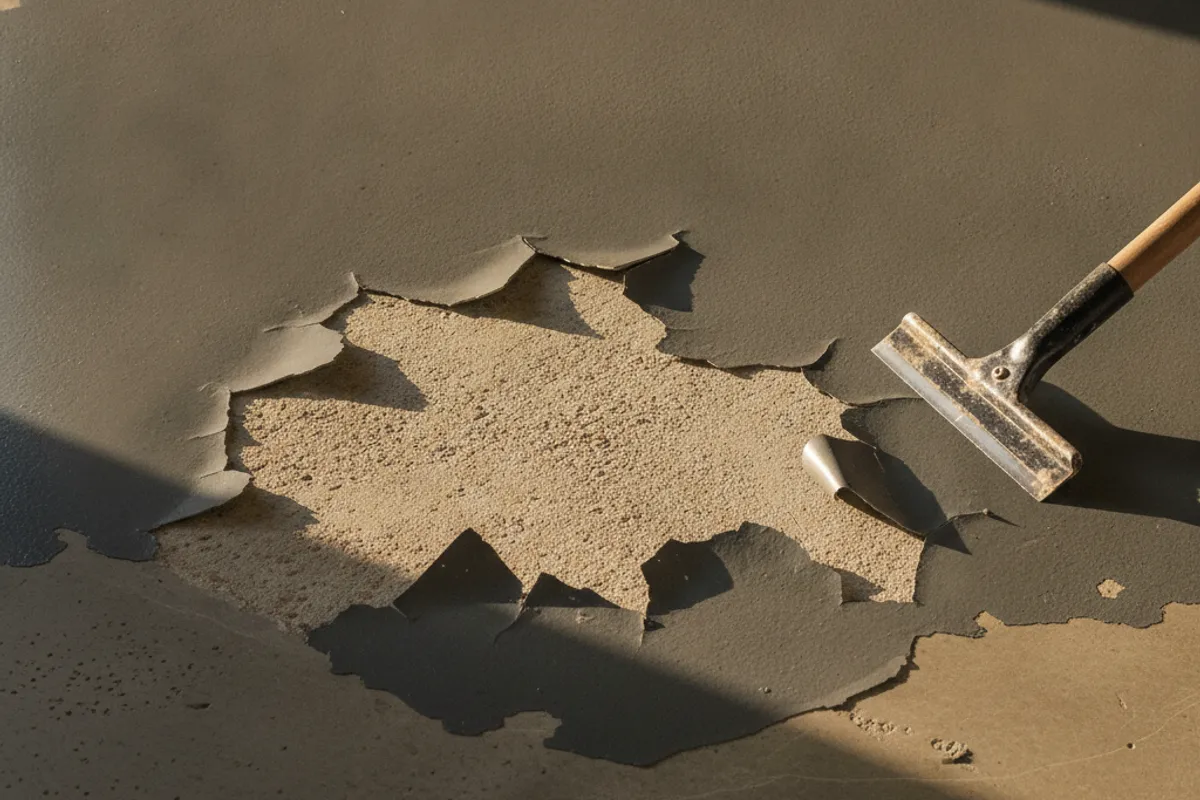
When epoxy starts peeling, the floor is telling you something
A peeling epoxy floor is one of the more frustrating problems a San Diego homeowner can discover in their garage. The investment looked good on installation day. Now there are bubbles lifting near the door, strips peeling in the tire lanes, or whole sections pulling up from the slab. The temptation is to peel off the loose pieces, buy a patch kit, and call it done.
That approach almost never works long-term. Understanding why epoxy peels in the first place is the key to choosing a repair path that actually holds.
What causes epoxy to peel
Epoxy delamination (the coating separating from the concrete beneath it) has a handful of root causes. The symptoms look similar, but the cause determines what fix is appropriate.
Poor surface preparation. This is the most common cause by a significant margin. Concrete has a weak surface layer called laitance that must be mechanically removed before epoxy is applied. When contractors skip proper diamond grinding and instead rely only on acid etching or cleaning, the epoxy bonds to that fragile layer rather than to solid concrete aggregate. When stress is applied: vehicle traffic, thermal cycling, moisture vapor, the coating separates at the weak interface.
If your floor was installed by a contractor who described the prep as “cleaning and etching” rather than “grinding,” prep failure is the likely cause.
Moisture vapor transmission. Concrete slabs breathe. Moisture vapor moves upward through the slab from the ground beneath it, a process driven by the moisture gradient between damp soil and the drier air inside the garage. If that vapor cannot escape through the coating, it builds pressure at the concrete-to-coating interface. Over time, small bubbles form, expand, and eventually lift sections of the floor.
Older slabs in neighborhoods like Spring Valley, La Mesa, or National City, where original construction often included minimal vapor barriers under the slab, are particularly susceptible. Moisture-related delamination often appears as bubbles or blisters, sometimes in isolated clusters rather than uniform patterns across the floor.
Hot tire pickup. Car tires reach significant temperatures during driving. When a hot tire parks on an epoxy surface, the softened epoxy can bond temporarily to the tire. When the car moves, the coating tears away. This typically shows up as strips or patches in the tire contact zones specifically, with the rest of the floor intact.
Hot tire pickup is most common with thin, water-based epoxy products or floors that were installed without a hard polyaspartic topcoat. It is accelerated in hot inland San Diego garages in Santee, Escondido, or El Cajon where garage temperatures regularly exceed 90 degrees on summer afternoons.
Improper mixing or application. Epoxy is a two-component product, a resin and a hardener, that must be mixed in exact ratios and applied within a specific pot life window. Off-ratio mixing produces epoxy that does not fully cure. The result is a soft, tacky, poorly adhered film that will fail under normal use. Similarly, applying epoxy that has exceeded its pot life produces a layer with compromised cross-linking and reduced adhesion.
This type of failure tends to produce widespread soft areas or unusual surface textures rather than isolated peeling zones.
Contamination on the slab. Oil, grease, silicone, and even some concrete curing compounds create contamination zones where epoxy cannot bond. A floor with historic oil drips from a vehicle, even if the surface looks clean to the eye, can have invisible contamination that prevents adhesion in specific spots.
Diagnosing your specific failure
Before deciding on a repair path, you need to understand the scope and cause of the failure. Some things to assess:
Tap the floor. Knock on areas that look solid. A hollow sound indicates the coating has already separated from the concrete beneath, even if it has not yet lifted visibly. A solid sound indicates good adhesion. Map out which areas are hollow, this tells you the true extent of the delamination.
Look at the pattern. Peeling concentrated only in tire lanes suggests hot tire pickup. Blistering in random clusters suggests moisture vapor. Peeling at the edges and near the garage door suggests moisture entry from outside. Uniform peeling or softness across the whole floor suggests a mixing or prep failure.
Look at what is on the back of the peeled pieces. If the pieces come up with concrete aggregate stuck to the back, the coating was well-bonded to the concrete but the concrete itself failed (rare, and indicates a weak concrete mix). If the pieces come up clean on the back, the epoxy never bonded to the concrete, a prep or contamination issue.
Check for moisture. Tape a piece of plastic sheeting to the bare concrete in a peeled area, seal the edges with tape, and leave it for 24 hours. If moisture collects on the underside of the plastic, the slab is transmitting vapor. This matters for what needs to happen before any repair or reinstall.
Repair options: what actually works
There is a spectrum of repair approaches. Matching the repair to the actual failure type and scope is what determines whether it lasts.
Targeted patch for isolated mechanical damage. If the floor is generally well-bonded but a specific section has peeled due to a single event, a sharp impact, a dragged heavy object, a targeted garage floor repair is appropriate. The damaged area is ground back to bare concrete, the edges are feathered, and a compatible epoxy patch is applied. This works when the surrounding floor adhesion is confirmed solid.
Topcoat recoat for surface wear without delamination. If the base coat is still well-adhered but the topcoat has worn through or UV-degraded, a surface abrasion and topcoat recoat can extend the floor’s life significantly. This is not appropriate if there is any underlying adhesion failure.
Full removal and reinstall for systemic delamination. When delamination is widespread, when moisture testing shows active vapor transmission, or when the original prep was clearly inadequate, there is no shortcut. The existing coating must be removed, typically by grinding or shot blasting, and the floor reinstalled from scratch with correct prep.
This is the most expensive path and the one homeowners most want to avoid. But a partial fix on a floor with a systemic adhesion problem will reproduce the same failure in a shorter timeframe. The economics of doing it right once versus patching it twice usually favor the full reinstall.
Moisture mitigation before reinstall. If moisture testing shows active vapor transmission, a moisture barrier coating must be applied to the bare slab before any new epoxy layer goes down. Skipping this step on a known moisture-active slab will produce the same delamination failure regardless of how good the new coating is.
What does not work: the patch-over-peeling approach
The most common mistake homeowners make when dealing with peeling epoxy is patching over the failing sections without addressing the underlying cause. This approach is appealing because it is cheaper and faster. It does not hold.
If the original coating failed because the prep was inadequate, patching over it means the patch is bonding to the same poorly-prepared surface. If moisture vapor caused the failure, patching without addressing moisture means vapor will find the edges of the patch and lift it as well. In most cases, patch-over-peeling fails within one to two years, often faster than the original installation failed.
The only time a patch makes sense is when:
- The surrounding floor adhesion is confirmed solid (knock test and edge inspection)
- The cause of the localized failure is mechanical and non-recurring
- The patch product is fully compatible with the original coating chemistry
A contractor who recommends patching without investigating the cause is not giving you a reliable repair. A good diagnosis comes before any product recommendation.
Getting the repair done right in San Diego
Epoxy Coat SD works with homeowners across San Diego County, from Chula Vista and National City in the south, through La Mesa and El Cajon, and up through Poway, Carlsbad, and Oceanside, to get peeling and failing floors properly assessed and correctly repaired or reinstalled.
Epoxy Coat SD is a referral service, not a contractor. Verify any installer at cslb.ca.gov. We connect homeowners with vetted, insured local contractors. Before any contractor begins work on your floor, verify their C-33 license at cslb.ca.gov. A licensed, insured contractor is the only appropriate choice for this type of structural floor work.
When you call us, we will ask specific questions about your floor: when it was installed, what prep you were told was done, how the peeling is patterned, whether you have any basement or under-slab moisture concerns. Those details help us match you with the right contractor for your specific situation.
Choosing the right system for the reinstall
If your assessment leads to a full reinstall, the good news is that a properly installed replacement floor should last significantly longer than the original, particularly because you now know what went wrong.
The systems that hold up best in San Diego garages combine a high-build epoxy coating base with a polyaspartic topcoat for UV stability and hardness. If the original floor used a thin water-based system, the upgrade in durability is significant. If the garage gets significant sun exposure, the UV stability of a polyaspartic topcoat solves the yellowing and softening problem that affects standard epoxy over time.
For garages with confirmed moisture vapor issues, the reinstall should always include a moisture-mitigating primer or barrier coat as the first layer before any decorative epoxy goes down.
Call to get started
If your floor is peeling and you are not sure what to do next, call us at (858) 925-5546. We can talk through what you are seeing, help you understand what it likely means, and get you connected with a contractor who will diagnose it correctly before recommending a solution.
A peeling epoxy floor is fixable. The key is fixing it in a way that does not need to be fixed again.