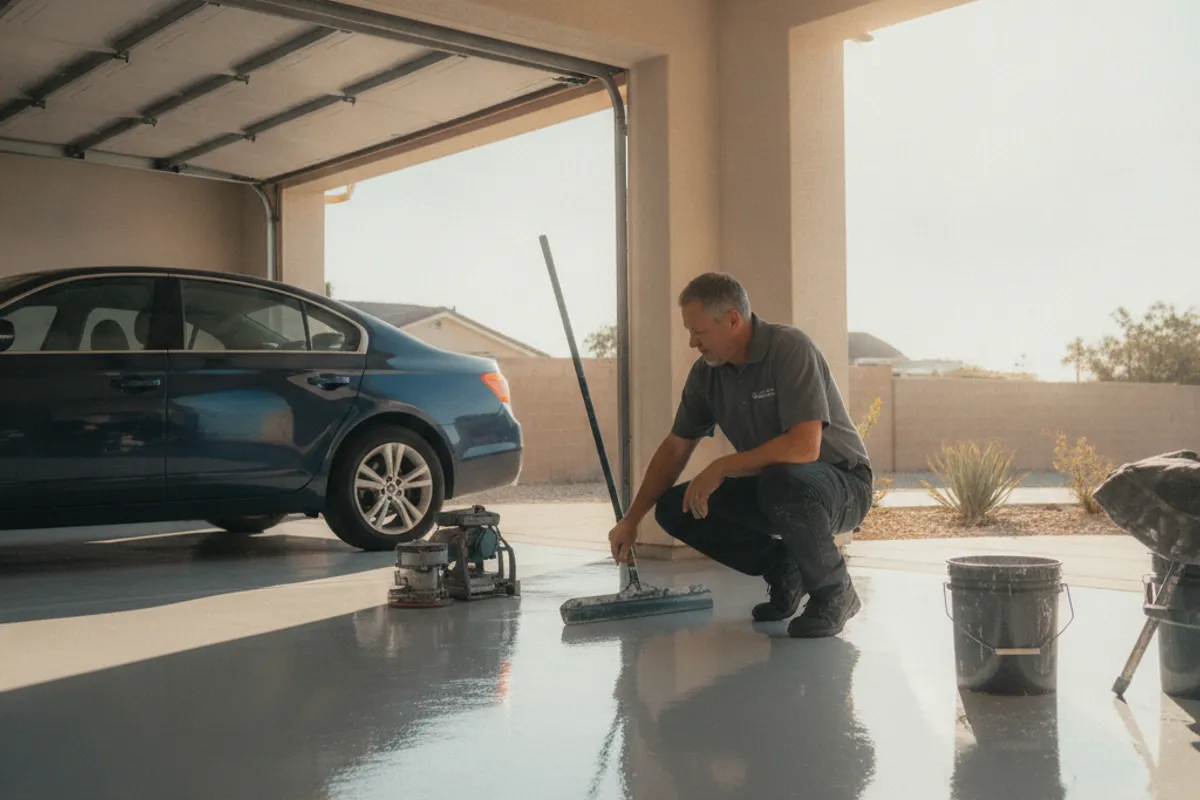
San Diego garages get hotter than most people expect
Most San Diego homeowners think of the local climate as moderate, and at the coast, it mostly is. But move inland to Santee, El Cajon, Lakeside, or Ramona, and summer garage temperatures tell a different story. Interior garage temperatures on a July afternoon in these areas can reach 100 to 120 degrees Fahrenheit, especially in south or west-facing garages with limited ventilation.
Even in coastal communities like Carlsbad or Encinitas, garages with concrete slabs absorb and retain heat in ways that affect epoxy floor performance. And the sun angle in Southern California means UV exposure is a year-round variable, not just a summer concern.
If you are investing in an epoxy coating for your garage, understanding how heat and UV affect coating performance helps you choose the right system and set accurate expectations.
How heat affects epoxy floors
Epoxy is a thermoset polymer. Once it cures, it does not melt, but it does soften at high temperatures. This is the source of the phenomenon most San Diego homeowners have heard about: hot tire pickup.
When a car is driven and then parked, the tires carry significant heat from friction and the road surface. When a hot tire sits on an epoxy floor, the softened epoxy can stick to the tire surface. When the car is later moved, the tire pulls coating away with it, leaving bare concrete patches or strips on the floor.
Hot tire pickup is more likely when:
- The floor was installed with a water-based or thin epoxy product
- The slab was not properly prepared before coating, reducing adhesion strength
- The topcoat is worn or absent
- The garage interior temperature regularly exceeds 90 degrees Fahrenheit
The fix is not avoiding epoxy: it is choosing the right system. High-build 100% solids epoxy with a polyaspartic topcoat handles normal hot-tire conditions well in San Diego garages. The polyaspartic layer is harder and more heat-tolerant than epoxy alone, and the underlying bond strength from proper concrete grinding preparation gives the coating enough adhesion to resist pulling forces.
The UV problem: why standard epoxy yellows
San Diego receives approximately 266 days of sunshine per year, with sun angles that deliver significant UV intensity even outside summer. For garages with windows, exposed south-facing doors, or skylights, UV exposure is a constant factor.
Standard epoxy is not UV stable. Under prolonged ultraviolet exposure, the aromatic chemical bonds in the epoxy resin break down in a process called photodegradation. The floor begins to yellow, often unevenly, creating a patchy amber tint over what was once a clear or light gray coating. Eventually the surface becomes chalky and brittle.
This is not a defect in the installation. It is a known property of epoxy chemistry. The solution is to apply a UV-stable topcoat over the epoxy base. The most common option is polyaspartic.
Polyaspartic coatings use aliphatic chemistry rather than aromatic chemistry, which means they do not undergo the same UV-driven degradation. A polyaspartic topcoat over an epoxy base coat stays clear or lightly tinted essentially indefinitely under normal sunlight exposure. It does not yellow, chalk, or lose gloss from UV.
If your garage gets direct sun exposure for several hours a day, common in east-facing garages in Poway, south-facing garages in Chula Vista, or garages in open-lot neighborhoods in Escondido, a UV-stable topcoat is not optional. It is the difference between a floor that looks good for fifteen years and one that looks faded within three.
Thermal cycling: the stress no one talks about
Beyond acute heat events, the daily temperature cycle in San Diego garages puts stress on epoxy floors in a different way. Concrete expands when it heats and contracts when it cools. In inland areas, the swing between a hot afternoon and a cool morning can be 40 degrees or more. On the coast, the range is smaller but still present.
This expansion and contraction happens constantly, and the concrete slab moves slightly with each cycle. The coating bonded to its surface must flex with it. Over time, a coating with inadequate adhesion or insufficient flexibility develops micro-cracks at stress points. Water and moisture vapor work into those cracks. Delamination follows.
The answer to thermal cycling stress is the same as the answer to most epoxy performance questions: correct surface preparation and the right product. A floor with strong mechanical adhesion to properly ground concrete can accommodate normal thermal movement without cracking. Thin, weakly bonded coatings cannot.
Moisture is part of this equation too. In areas like Spring Valley or La Mesa where older slabs sit on minimal vapor barriers, rising moisture vapor already stresses the coating from below. Thermal cycling adds additional mechanical stress on top of moisture pressure. For these installations, a moisture barrier coating applied before the epoxy layer is the correct approach.
Choosing the right system for a hot San Diego garage
The coating systems that perform best in San Diego’s heat and UV conditions share a few characteristics.
Aliphatic or polyaspartic topcoat. This is the most important choice for UV-exposed garages. Polyaspartic topcoats are available in matte, satin, and high-gloss finishes, and they maintain appearance and structural integrity under prolonged sun exposure. A polyaspartic coating applied as the topcoat layer effectively eliminates the UV yellowing problem.
High-build base coat. More thickness means more material between the surface and the concrete. A 100% solids epoxy base at proper thickness gives the floor more resistance to both mechanical wear and the hot tire pickup phenomenon.
Full broadcast systems. Adding a decorative chip or flake broadcast into the base coat before the topcoat adds texture and significantly increases the surface area of polyaspartic coverage. The chip layer itself adds some thermal insulation and mechanical durability. A flake and chip floor system with a full broadcast coverage and polyaspartic topcoat is among the best-performing options for San Diego’s combination of heat, UV, and vehicle traffic.
Light colors. Darker floor colors absorb more heat from sunlight, which can accelerate both the hot tire pickup risk and thermal cycling stress. If you have significant sun exposure and want to minimize heat-related stress on the floor, lighter base colors and chips reduce thermal absorption.
What about metallic epoxy in hot garages?
Metallic epoxy floors, the swirling, pearlescent finishes increasingly popular in Encinitas, Del Mar, and higher-end neighborhoods, require slightly more consideration in hot conditions. The metallic pigments are suspended in epoxy, which means UV stability depends entirely on what topcoat is applied.
A metallic epoxy floor with a proper polyaspartic topcoat performs well in San Diego’s sun. Without the topcoat, the epoxy carrier can yellow and alter the appearance of the metallic pigments beneath. The floor itself may still be structurally sound, but the aesthetic changes significantly.
If you are considering a metallic epoxy finish, ask your contractor specifically what topcoat they apply and whether it is aliphatic (UV-stable). This is a question any experienced contractor should be able to answer directly.
Installation timing and temperature considerations
Epoxy has application temperature windows. Most systems need an air and slab temperature between 50 and 90 degrees Fahrenheit during application, with relative humidity below 85%. For San Diego garages, this is usually a non-issue in spring and fall. In summer, however, very hot inland garages may require early morning installation or additional ventilation to keep application temperatures in range.
Polyaspartic coatings have a wider temperature tolerance and cure faster than standard epoxy, which is one reason they are increasingly common as both base and topcoat in San Diego installations. They can be applied in slightly hotter conditions without the same risk of application defects.
If your project is scheduled for summer and your garage is in an area that heats significantly by midday, Santee, Lakeside, El Cajon, or inland Escondido neighborhoods, discuss scheduling with your contractor. Starting early and finishing before the garage reaches peak temperature is standard practice.
A note on patio and pool deck coatings
San Diego homeowners sometimes ask whether the same heat and UV concerns apply to outdoor epoxy applications. They do, often more intensely. Outdoor concrete surfaces in direct sun can reach 150 degrees Fahrenheit on a summer afternoon, which exceeds the thermal tolerance of standard interior-grade epoxy systems.
Exterior applications require systems specifically designed for outdoor exposure. Our patio and pool deck coating service describes the appropriate systems for outdoor San Diego conditions, which involve higher-temperature-rated chemistry and dedicated UV protection from the base coat up.
Getting matched with the right contractor
Epoxy Coat SD connects homeowners across San Diego County with insured contractors who have experience with local conditions. Epoxy Coat SD is a referral service, not a contractor. Verify any installer at cslb.ca.gov. Any contractor you hire should hold a C-33 license from the California State License Board, which you can verify at cslb.ca.gov.
We serve homeowners from Oceanside and Vista in the north, through San Diego and La Mesa, and inland through Lakeside, Santee, El Cajon, and Alpine. Heat and UV conditions vary across these areas, and the contractor we match you with will account for your specific garage’s exposure when recommending a coating system.
Call us at (858) 925-5546 to get started. We will ask about your garage’s orientation, sun exposure, and how you use the space, then connect you with a contractor who installs the right system for San Diego’s climate, not just a generic product that works somewhere else.
A correctly specified epoxy floor performs well through years of heat, UV, and thermal cycling. The key is knowing what to specify before installation day.